
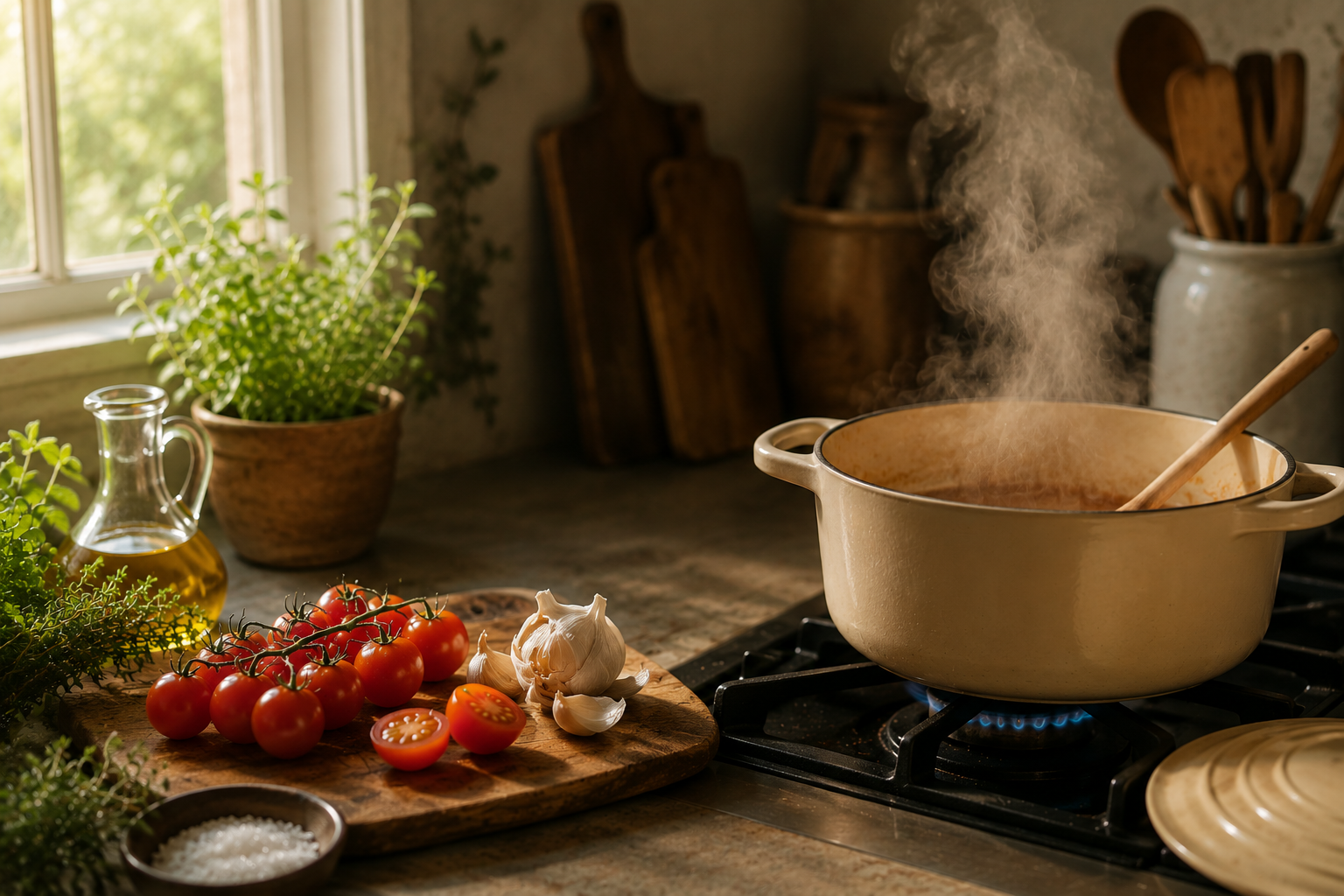
“It’s late when you get home. You open the fridge almost without thinking, pull out something easy, slide it into the microwave and wait for the familiar beep. By the time you sit down, you’re already scrolling through your phone. We’ve all done it. Yet somewhere along the way, something quietly disappeared. When did we stop cooking and start merely reheating food?”
There was a time—not so long ago—when cooking meant peeling, chopping and waiting patiently for something to simmer. When the smell of onions gently cooking in olive oil announced dinner long before anyone was called to the table.
Today, waiting makes us uneasy. Advertising knows this. It constantly tells us we never need to slow down—that everything can be instant, effortless and convenient. We accept the promise because our lives really are busy. But every time we do, we leave something behind.
Labels
Behind convenience lies a list of ingredients we often cannot even pronounce. Preservatives designed to stop time from touching our food. Chemicals that recreate textures so our palate never notices what is missing.
Hidden behind the label is another cost—one that goes beyond the price we pay at the checkout. It is the gradual erosion of our health, almost without us noticing. It is a palate that slowly adapts to flat, predictable flavours and eventually stops asking for anything more.
Tomatoes are bred to travel well rather than taste good. Fruit is picked before it’s ripe, stored in cold warehouses and shipped across continents. Perfect-looking produce fills supermarket shelves while flavour quietly disappears. Little by little, the tastes we once knew fade away.
Our perception of flavour changes too. When almost everything arrives ready-made, we stop noticing the small things: the scent of freshly picked rosemary, the perfect ripeness of a tomato, or the way a sauce quietly transforms as it cooks.
Always in a Hurry
Something changed when the internet entered our lifes, and it wasn’t only how we searched for recipes. It changed the way we wait.
We became accustomed to immediacy—in work, communication and entertainment—and that acceleration inevitably found its way into our kitchens. Today, many of the recipes we see online seem to follow the same formula: quick to make, impressive to look at and impossible to get wrong.
Cooking has become, in many cases, another race against the clock. And in that race, where does enjoyment fit?
Of course on weekdays we don’t have much time, and there is nothing wrong with that. That’s exactly why batch cooking has become so popular: cooking calmly in advance and adapting those meals throughout the week.
The real problem isn’t the lack of time itself. It’s the idea we’ve accepted without questioning—that being busy every minute somehow means we’re successful. That sitting down to cook, reading a book or lingering around the table after a meal is somehow wasting time.
Yet some of life’s most valuable moments—a conversation without urgency, a stew that needs an hour to become itself—only exist when we deliberately choose not to optimise every minute.
Growing Slower
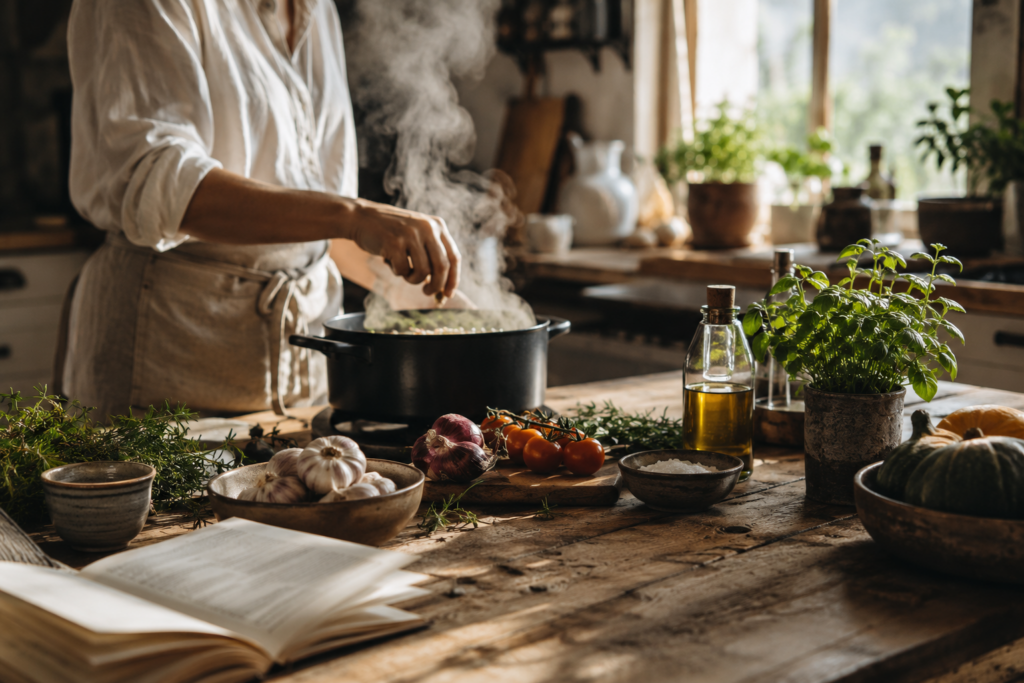
Fortunately, another movement is quietly emerging. Without seeking attention or perfection, more and more people are returning to a more honest way of cooking: choosing organic, seasonal ingredients grown close to home. Tomatoes that only taste like tomatoes in August. Pumpkins that patiently wait until October to offer their sweetness. Fresh herbs growing in a pot beside the kitchen window—a daily reminder that something alive is waiting for us at home.
This isn’t a cuisine that can be completely improvised. It asks for curiosity and intention: paying attention to the seasons, getting to know local growers, accepting that not everything should be available all year round, and understanding that waiting isn’t deprivation—it’s part of flavour itself.
Planting a fruit tree changes the way you think. You know it will take years before it bears fruit, and yet you plant it anyway. In an age when we expect everything tomorrow, that simple gesture feels quietly radical.
I have an apple tree in my garden, and I never imagined how much joy it would bring each autumn: picking the apples, making juice, baking pies, cooking compotes and sharing them with friends and family.
Watching
No one ever taught me. I simply grew up watching. Every Saturday my grandmother kneaded bread without a written recipe, her hands covered in flour almost to her wrists, while I sat nearby, quietly observing.
I can’t remember her explaining measurements. What I remember is the sound of the dough hitting the wooden table, the smell of the oven warming since early morning, and the patience of someone who simply wasn’t in a hurry.
Today, if I’m honest, I’d struggle to ferment dough, bake bread or prepare many traditional recipes without first watching a video online. Not because I’m less capable than she was, but because I never had to learn that way.
That knowledge remained in her hands and never fully reached mine. I grew up in a different kitchen—faster, busier and filled with packages carrying printed instructions.
Only now, as I slowly return to that slower rhythm—kneading dough on a Sunday, letting a sauce simmer all afternoon—do I understand what it means to recover more than a recipe.
You recover a way of living.
Cooking slowly has taught me that there is chemistry in the way heat transforms texture, precision in getting the proportions right, and something close to poetry in the way a single taste can return you to a moment you thought had been forgotten.
The Table
Perhaps what we are truly losing isn’t the recipe itself but everything surrounding it. A table laid without haste. Conversations that naturally stretch because the meal is still cooking and nobody minds waiting. Family celebrations centred around a busy kitchen filled with helping hands, overlapping voices, someone checking the oven while others set the table.
My grandmother’s lasagna wasn’t memorable simply because of its layers or its béchamel. It tasted of something else entirely: time. Every slow stir, every patient wait, every quiet hour she gave to it found its way onto the plate.
My mother’s pumpkin soup, with that perfect hint of nutmeg that no one has ever managed to recreate quite the same way, was never just a recipe. It was her way of saying I’ve been thinking about you without ever needing the words.
Those dishes cannot be packaged. They don’t belong inside a plastic tray with microwave instructions. They belong to a kind of time measured not in minutes, but in presence.
Returning
This isn’t about rejecting modern life, nor pretending that everyone can grow a vegetable garden or bake bread every Sunday.
Perhaps it’s simply about recovering small rituals: a basil plant on the windowsill, buying what’s naturally in season, cooking a family recipe from time to time simply for the pleasure of keeping something alive through our own hands.
None of these small rituals will change the world. But they might change the way we move through it. They remind us that some things become valuable only because they cannot be rushed.
And perhaps that is what cooking has always been trying to teach us.
Leave a Reply